Naber
Naber: Where Neighbourhoods Grow
The Problem Nobody Talks About
Here's something we don't say out loud often enough: most of us don't know our neighbours. We share walls, stairwells, bin days, and building group chats that nobody posts in. We live in proximity to dozens of people and interact with essentially none of them.
The research is clear on what that costs us. Strong communities are built one relationship at a time, and personal wellbeing improves measurably when people build connections in their immediate local area. We know this. And yet the barriers keep winning: renters move on, schedules don't align, cultures and ages and family sizes create social distance even when the physical distance is a single flight of stairs.
The existing solutions weren't solving it. NextDoor is large, sprawling, and has a toxicity problem. Neighbourly has engagement issues. The apartment-focused alternatives depend too heavily on a single "super neighbour" champion to hold everything together. All of them let people hide behind screens, which is exactly the wrong direction if the goal is actual human connection.
Naber started from a different premise. What if the app's job wasn't to be the destination, but to make the real-world encounter easier?
Research: Going to the Primary Source
The most direct research method available was also the most obvious: move house, meet the neighbours, and ask them directly.
That's what happened. Four groups of neighbours. Real conversations. The questions were structured but light: what do you like about living here, what makes a good neighbour to you, is there anything I should know about the building, would you be open to catching up?
What came back was instructive. Two groups said consideration and quietness were non-negotiable. Two others independently mentioned the café around the corner as a shared touchstone. One group was open to a future catch-up. One offered a heads-up about the dripping aircons and the water system. One crucial piece of building infrastructure: bin day is Tuesday morning. Recycling is Wednesday.
And the most revealing finding of all: there was no central communication channel for the building. Nothing. No group chat, no noticeboard, no mechanism for neighbours to share basic information with each other.
That gap is where Naber lives.
A competitor analysis confirmed the broader market problem. The apps that existed were either too broad and too toxic, or too niche and too dependent on the right person showing up to run them. The consistent failure mode across all of them: they replicated the problems of social media inside a geographic boundary, and hoped that proximity would do the rest.
It doesn't.
The Insight That Shaped Everything
The core insight came from asking a deceptively simple question: how do I know if I'm a good neighbour?
Most people couldn't answer it cleanly. Being a good neighbour is something you feel like you either are or aren't, without any real feedback mechanism. You don't know if the person two doors down appreciated you taking in their parcel. You don't know that you've crossed paths with your upstairs neighbour fourteen times in the last month without either of you saying anything.
Naber's design thesis: make the invisible visible. Give people a way to see their neighbourhood as a living, active community, create low-stakes on-ramps to connection, and let the app reward the real-world behaviour rather than the in-app behaviour.
No comment sections. No public callouts. No ability to hide behind an avatar and log a noise complaint. The app's mechanics had to push toward IRL, not away from it.
The Product
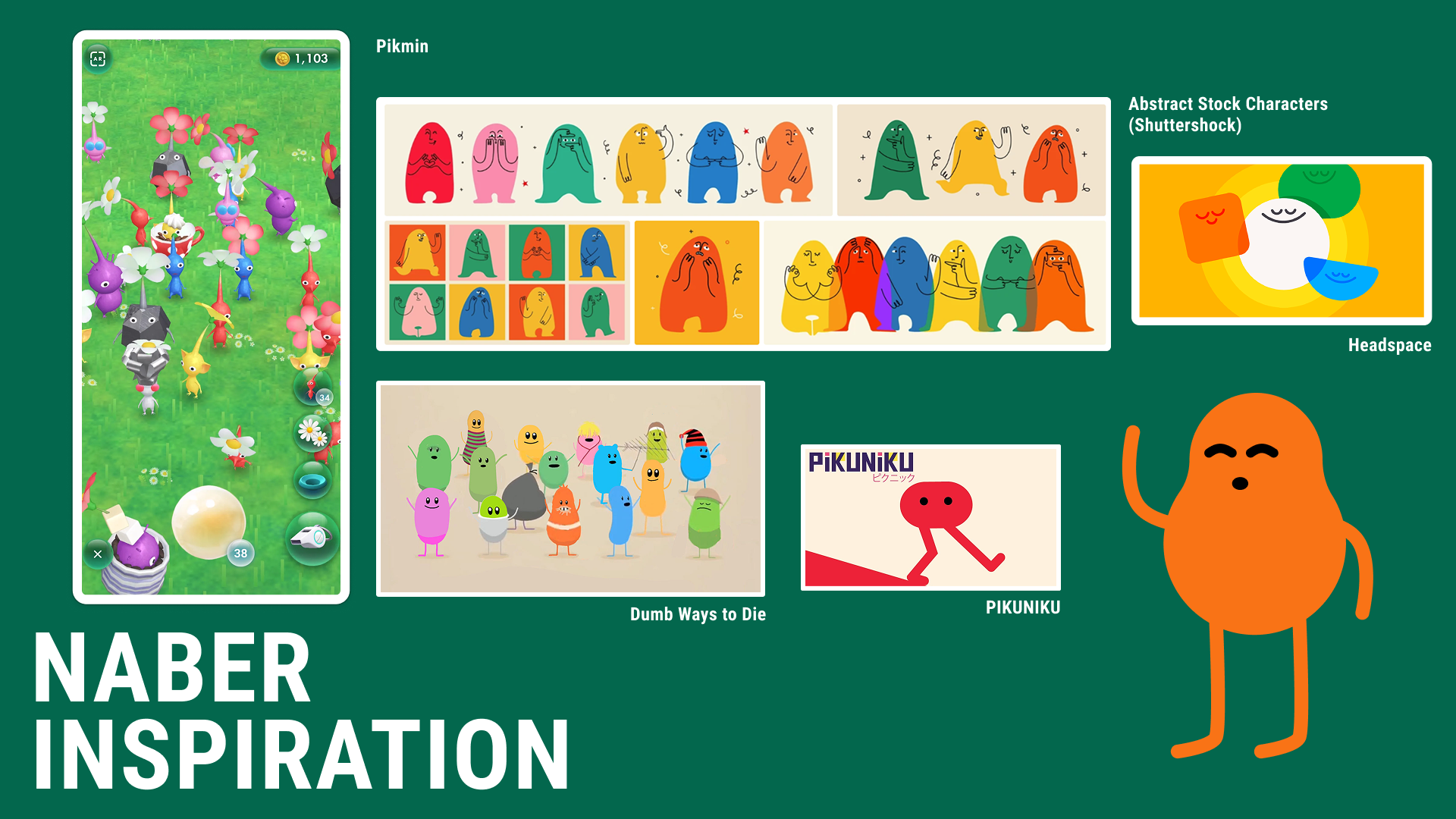
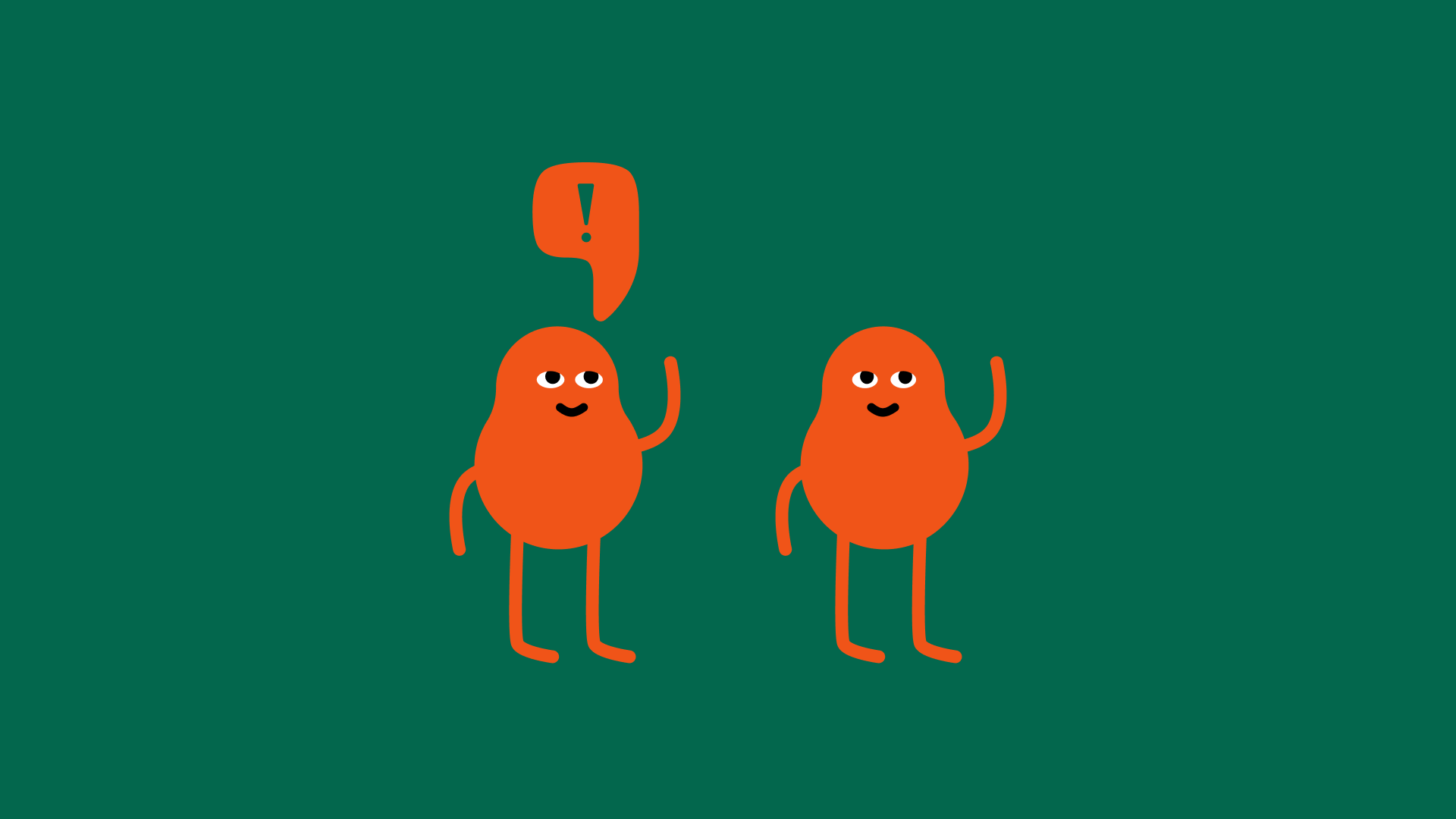
Nabers are your avatar in the app: abstract, colourful, deliberately not-quite-human. The decision to move away from realistic avatars wasn't aesthetic, it was structural. More human-looking characters invite more human-level judgment, comparison, and toxicity. Abstract characters lower the stakes. You're not representing yourself; you're representing your presence in the neighbourhood. The Naber is a surrogate that makes first contact feel less exposed.
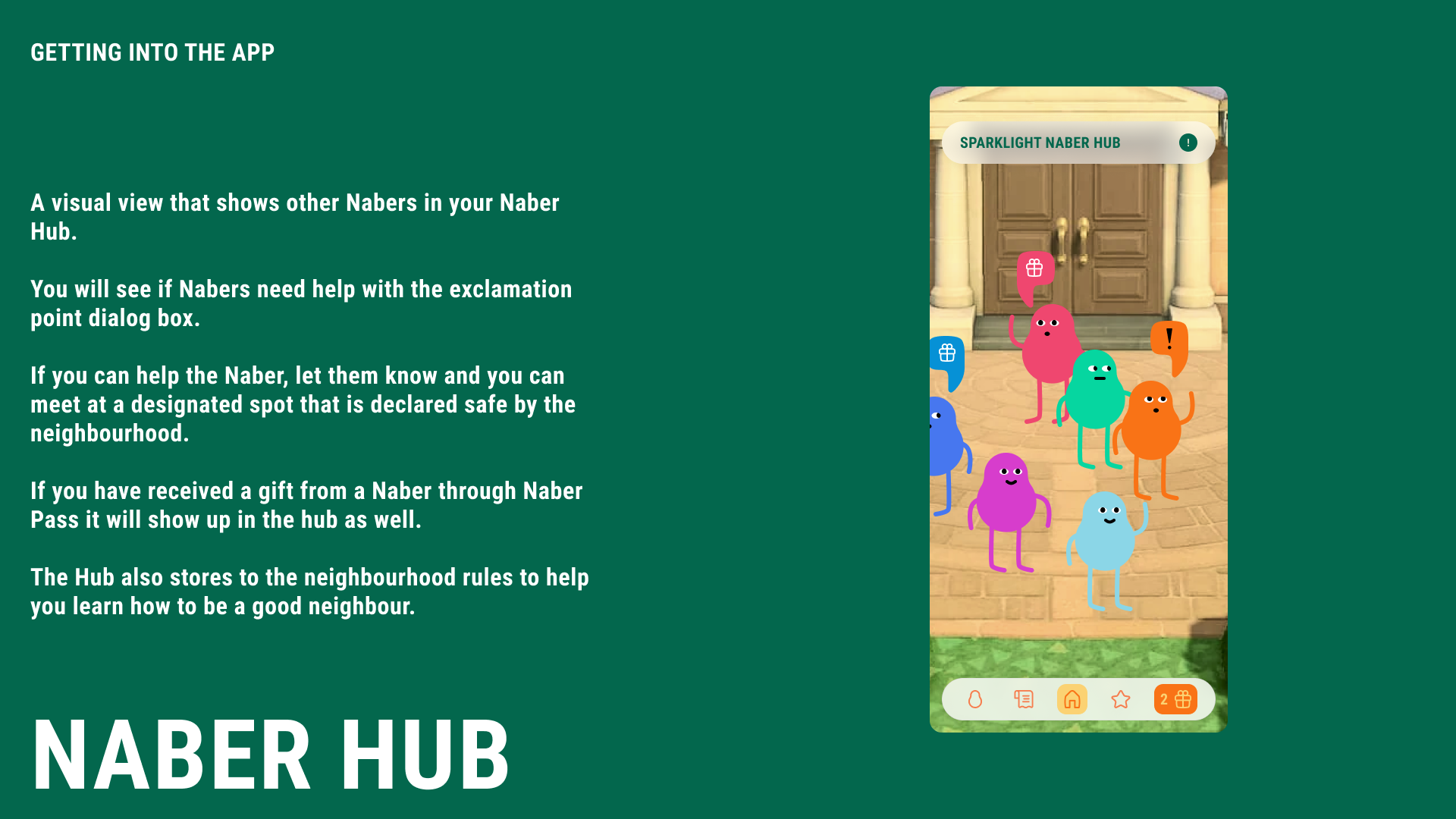
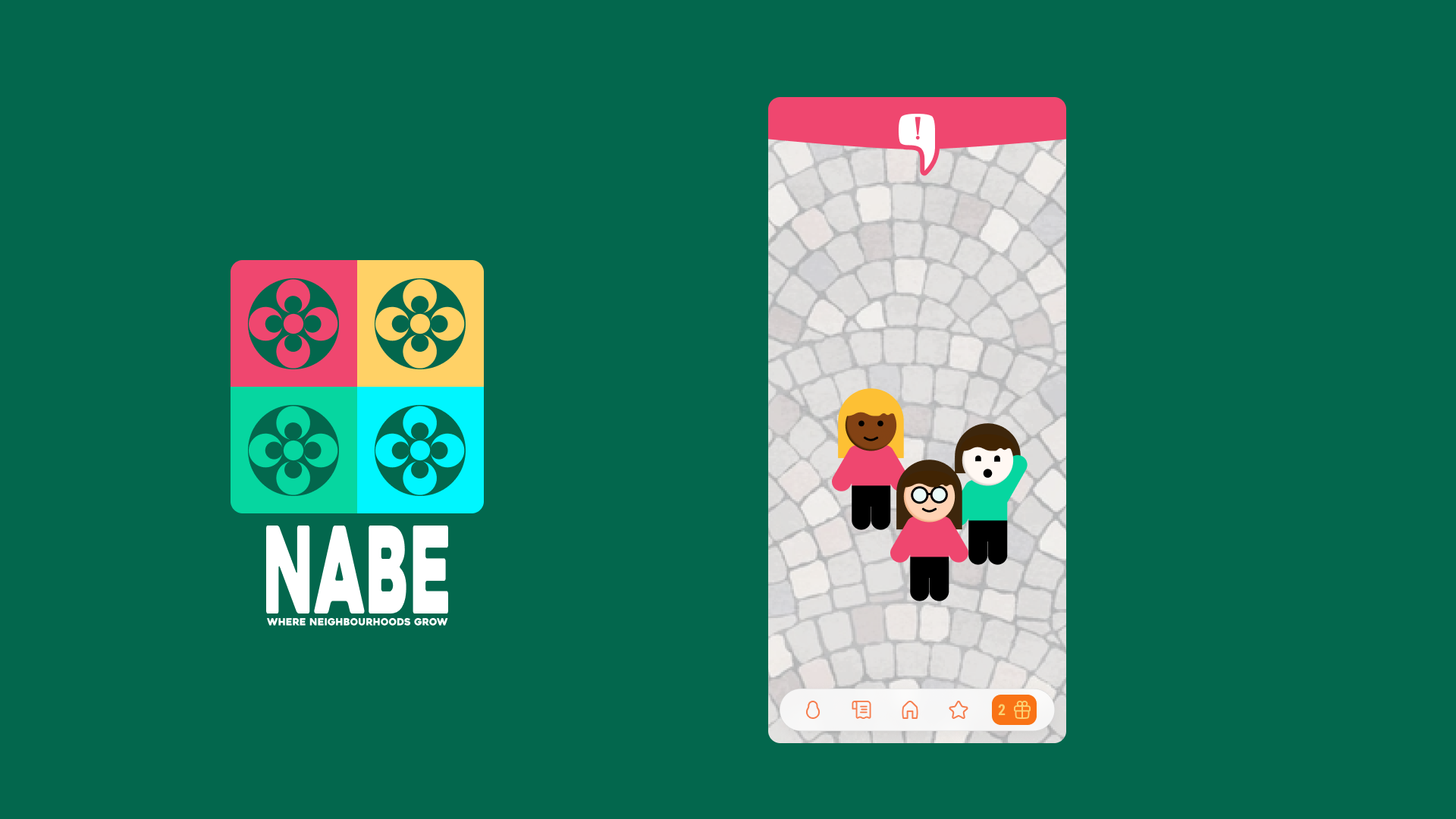
The Naber Hub is the centrepiece: a visual space showing the Nabers in your building or street, gathered in a shared environment. You can see if someone needs help (a small exclamation mark above their Naber), respond to that need, and arrange a meeting at a designated safe spot in the neighbourhood. It's a map of your community rendered in a way that feels approachable rather than surveillance-adjacent.
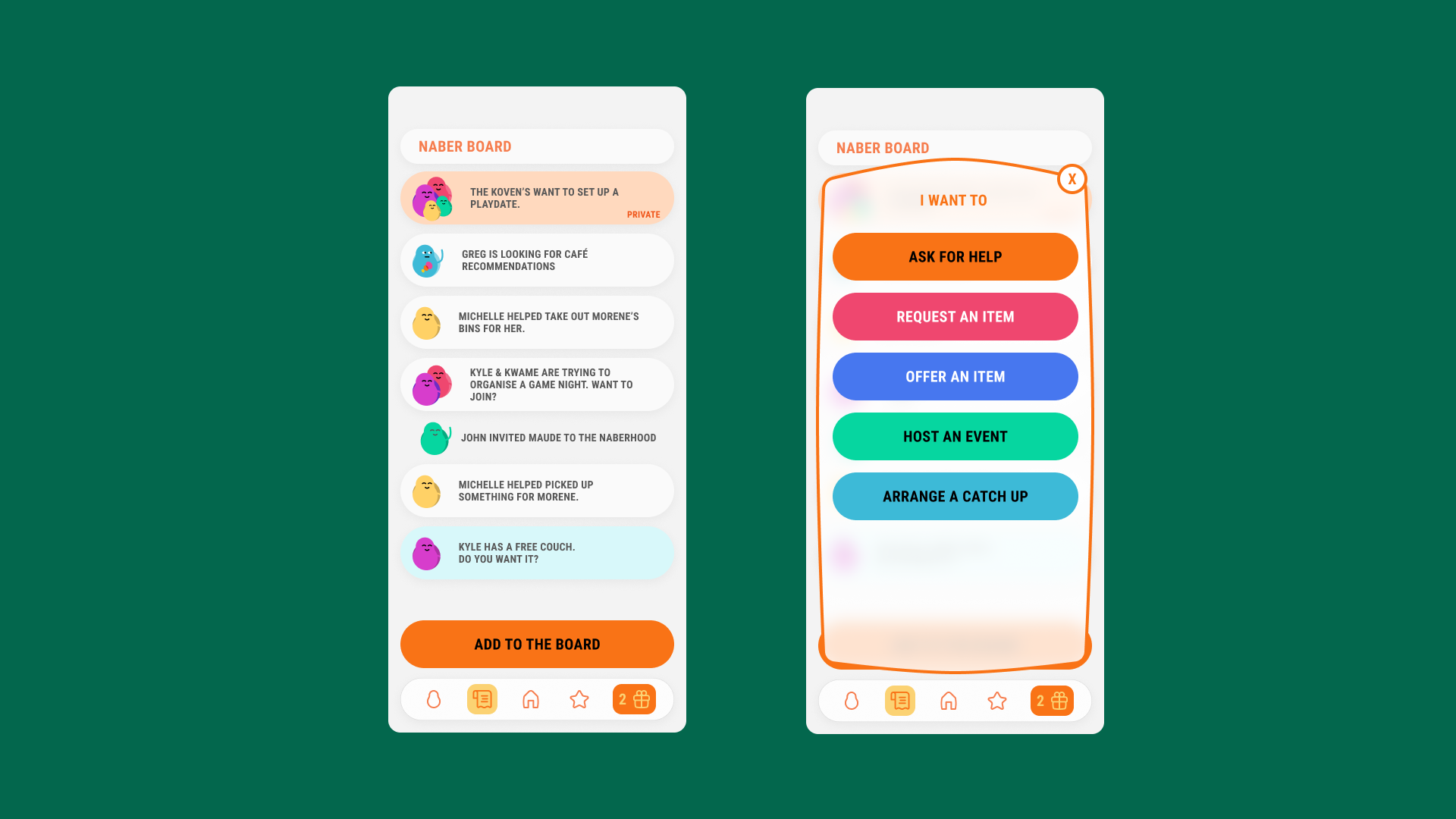
The Naber Board is the activity feed, but with the toxicity mechanisms removed. No comments. No reactions. Entries are actions: Michelle helped take out Morene's bins. Kyle and Kwame are organising a game night. Greg is looking for café recommendations. Kyle has a free couch. The board is a record of a neighbourhood actually functioning, and it gives newcomers a fast read on the culture of the place they've moved into. Private notes between two Nabers are available for anything that doesn't need to be public.
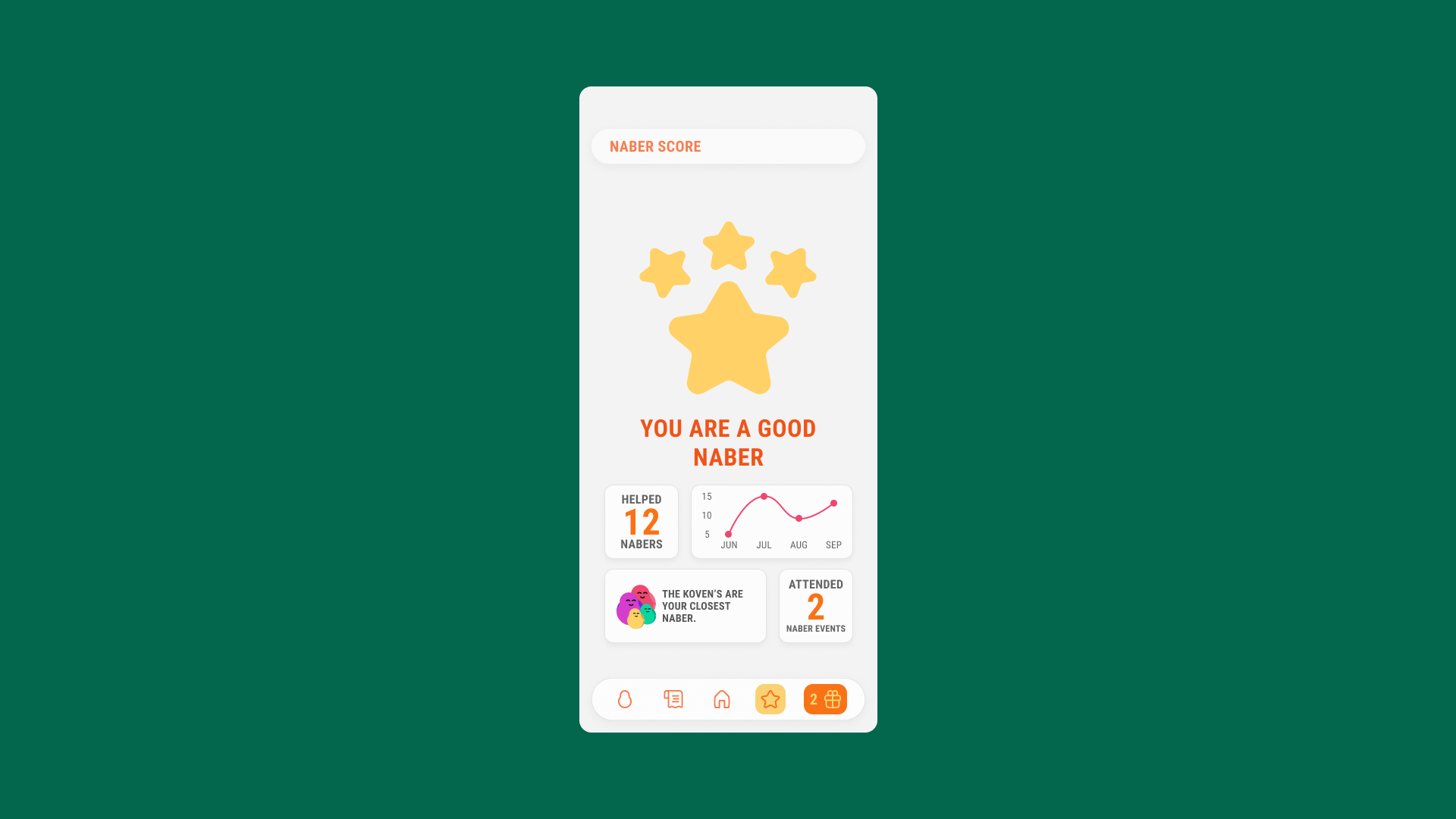
The Naber Score answers the question nobody could answer before: how good a neighbour am I? The score tracks real-world actions: helping a neighbour, attending or hosting events, showing up. Critically, the score is tied to a specific hub. Move house and you start again. This isn't punitive; it's honest. Goodwill is local, and it's built over time, not transferred.
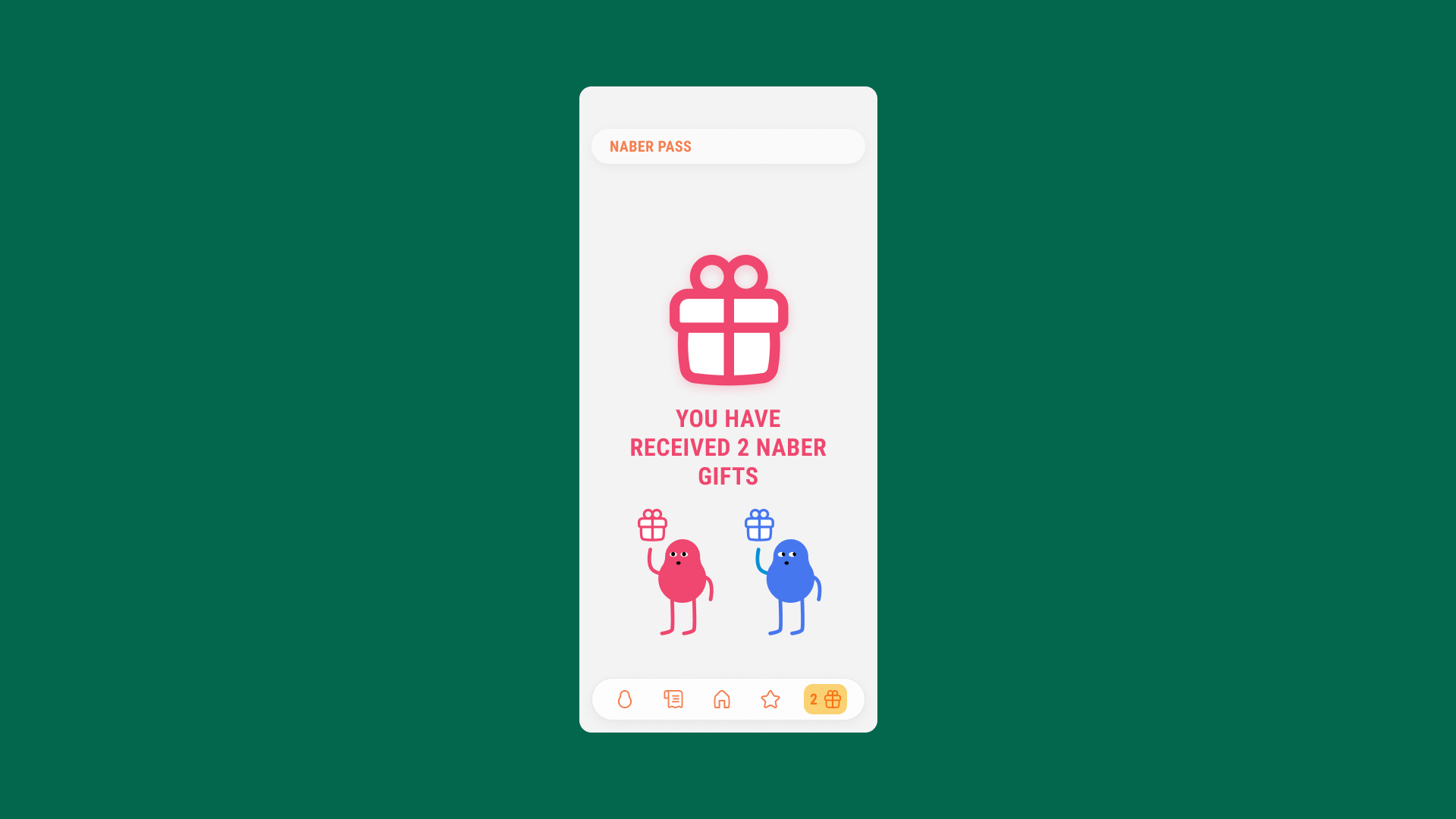
Naber Pass is the mechanic that makes the whole system feel like a game worth playing. When two Nabers physically pass each other in the real world, Bluetooth triggers a passive exchange and both receive a gift in the app. No interaction required beyond existing in the same space. The gift can be used to tend the shared Naber Hub: water the garden, plant seeds, place decorations. You find out how often you've crossed paths with someone, which gives you something to say the next time you actually stop.
What Changed Along the Way
The original name was Nabe. Clean, short, works as a word. It became Naber because the longer form gave the avatars a collective name that felt warmer. Nabers, plural, have a personality. Nabes didn't quite.
The first logo was a flower shape, four individuals viewed from above with hands outstretched. Intentional and meaningful. Also looked like it belonged on a restaurant's signage. It was replaced with three speech-bubble forms, which better communicated the connective, conversational intent of the product.
The avatars went through the same evolution. The initial direction was more Mii-like, more human. Privacy and toxicity concerns pushed the design toward abstraction. The shift also made the output more achievable inside the time constraints of the project, which is a real-world design consideration worth naming.
What Naber Is, Actually
Naber is a light-hearted, delightfully absurd app that exists to make one thing more likely: that you say hello to someone you live next to. The avatars lower the barrier. The gamification gives people a reason to keep engaging. The mechanics reward the real-world behaviour, not the screen time. And the lack of a comment section means the worst instincts of social media don't get to colonise the one place where geography has already done the hard work of putting you near each other.
The hypothesis underneath all of it: if you can make someone feel like their neighbourhood is alive, they'll start acting like it is.
What Comes Next
A pilot with real neighbours to validate the Naber Pass mechanic and score behaviour over time. Deeper privacy and safety research, because any app that knows where people are and who they live near carries a responsibility that can't be deferred. Desktop and tablet support to widen access. And a Naber customisation roadmap: shapes, hair, glasses, clothes, eventually a 3D version of the character you've built.
The neighbourhood is already there. Naber just helps people see it.
Naber, Product Design & Brand, 2025